The following post comes from a new contributor to the website – Alex. You can find out more about him in the about section I’m excited that this website has reached multiple people in such a short time that have volunteered their time and knowledge on financial subjects!
So you have done the math and after looking at all the hidden costs that was mentioned in our previous post, you decided that it is indeed a good idea to purchase a home so you can build equity and lay down roots in a community. In this post, we’ll talk about various financing options and closing costs that may be applicable so you have as much knowledge as possible to becoming a home buyer. We will be focusing specifically on the VA loan throughout the discussion.
Your average American citizen usually has a couple of options when getting a home mortgage loan: they can put a large down payment on the home (usually 20% of the purchase price) and finance the rest of it at a normal rate, or they can do a low/no down payment option which results usually in a higher rate and something called PMI.
What’s PMI? PMI stands for Private Mortgage Insurance. Whenever you get a mortgage from a lender and put less than 20% down, they are essentially taking on the risk of you not being able to pay the full agreed upon amount and foreclosing on the house. Although this insurance is for the lender’s benefit, they build this into their models and rates that you will end up paying. PMI rates can range from around .3% to 1.5% of a mortgage’s value. This leads to a higher monthly payment that does NOT help you build equity in any way — it just gets paid to the bank to help subsidize the risk of foreclosure. While this can go away later on once you have built your equity to 20% or above, keep in mind that not only does it not go away automatically, but by the time it does, you could have paid thousands in unnecessary payments. Another important thing to note is that it is not possible to get rid of this insurance if you have a FHA loan.
One of the major differences between VA loans and various other loans is that VA loans have no PMI, regardless of how much or how little of a down payment is made. This is because the VA itself subsidizes these loans and takes on the risk of nonpayment, allowing veterans and service members to save a lot of money if they don’t have a significant amount saved for a down payment.
“But wait, if there’s no PMI then what’s the point of making a down payment at all with a VA loan?”
While it is true that a traditional down payment is not required, everyone who borrows for a home via a VA loan is required to pay something called a “funding fee” (with the exception of veterans and service members who are receiving disability compensation). That aside, the VA loan funding fees are broken up as follows:
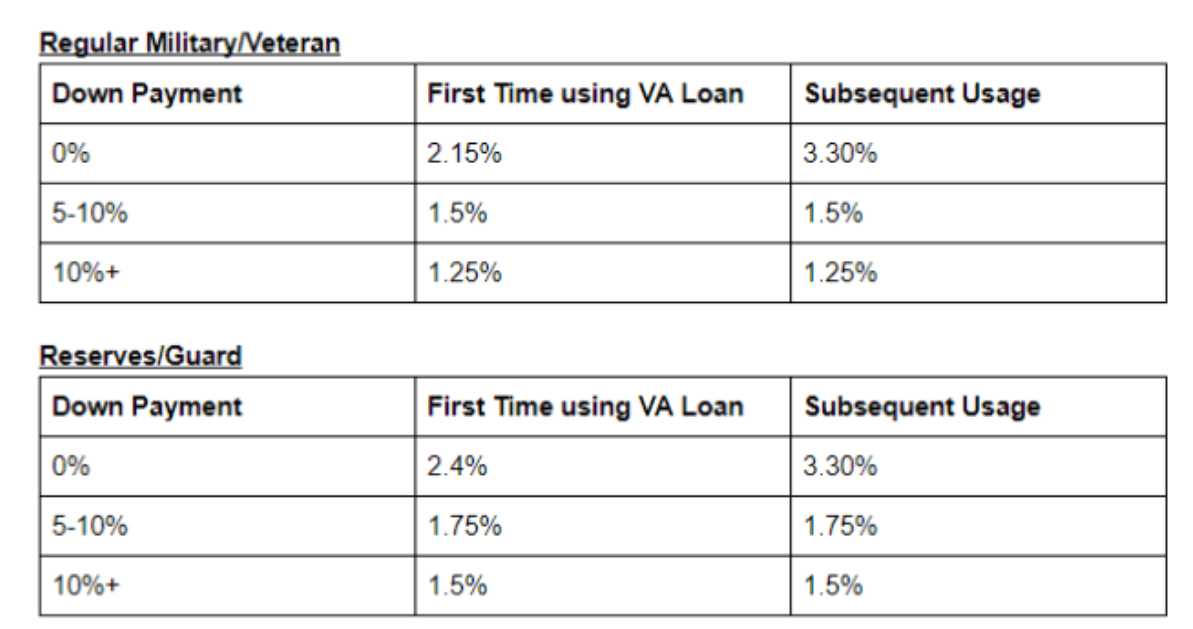
There are few things to note about the funding fees. First, these funding fees may be rolled into the mortgage if desired, allowing you to further lower the upfront cost of purchasing your new home and instead paying it off over the lifetime of the loan. Next, you’ll notice that the subsequent usages of the VA loan only increase your funding fee if you are making NO down payment – as such, if you’re going to purchase more than one home using the VA loan, it makes a lot of sense to have at least a 5% down payment ready to go.
For those that don’t know, the VA has a few stipulations in order to gain a mortgage through them: You must have served 181+ days in peacetime/90+ days in wartime/6 years in the Guard or Reserve, reside in the home as a primary resident, and must not have been discharged under dishonorable conditions. If you meet these conditions, you’re eligible for the VA loan, up to the maximum entitlement of $424,100 or specifically, $106,025 in actual entitlements – This isn’t the actual loan amount, but rather how much the VA will guarantee for you. Remember earlier how we mentioned PMI and risk to the bank? The reason VA loan rates tend to be lower and there’s no need for PMI is that the VA actually usually guarantees 25% of your loan amount.
Here’s how the math works: Say you purchase that $200,000 home and use the VA loan, while meeting all of the requirements. You then PCS a few years later and want to buy a home at your new location as well while renting out your old home rather than selling it.
$424,100 x 25% = $106,025 maximum entitlement
$200,000 x 25% = $50,000 used entitlement on first home
$106,025 – $50,000 = $56,025 entitlement remaining
$56,025 x 4 = $224,100 actual home purchasing power remaining
Alternatively, you can just subtract the purchase price of your home from $424,100 to find what’s remaining, but I find it can help to understand the underlying principles.
Now that we understand the specifics of the VA loan system, it’s time to start looking at getting that mortgage! Besides the FHA/conventional/VA types of loans, there are also two major subtypes of mortgages: fixed and adjustable-rate. Generally, when we’re talking about fixed, we’re talking about 15 year and 30 year mortgages (although there are other timelines available), while with an adjustable rate (generally referred to as an ARM) we’ll talk about something called a “5/1 hybrid ARM” as an example.
A fixed rate mortgage is just that: a mortgage with a fixed rate! Your monthly payments will never increase, nor decrease without refinancing on a fixed rate mortgage. This can be a major benefit, as you know exactly what your monthly mortgage is going to be for the next 15/30 years (barring major changes in taxes or homeowner’s insurance). When you choose a fixed rate mortgage, you are provided an interest rate, which is generally higher the longer the term of the loan. This is because as time goes on, interest rates will change, and the mortgage provider is hedging their bets and lowering their risk by providing you with a slightly higher, guaranteed price over the next 15 or 30 years.
On the flip side of this, we have ARMs (the Adjustable Rate Mortgages) – these can fluctuate from year to year, based on the current interest rate. The numbers in front of it refer to how often these rates can be changed – in our 5/1 example, the 5 means you’ll have 5 years before your rate is eligible to change at all, and the 1 means that your rate will be eligible for change every year after that. For VA loans, your rate can only increase by 1% a year, and up to 5% over the lifetime of the loan. While they often have slightly lower rates, they make up for it as the loan matures and your mortgage payment can increase year to year and cause financial hardship. The benefit is that you can often get a lower rate compared to a fixed rate mortgage, since the bank isn’t taking on as much risk – they can just raise your rates later on if interest rates go up.
As an example, let’s look again at that median $200,000 home and assume you got a 5/1 ARM on it with a 3% interest rate. This would mean you have a monthly payment of $843. For 5 years, your payment would continue to be the same, but in the 6th year, your interest rate goes up by 1% increasing your monthly payment to $954. The next year, it could increase again by another 1% to 5% total, this time increasing your monthly payment to $1,073 and so on and so forth… In this example, the highest it could cap is at 8%, or a whopping $1,467 monthly payment – a hefty increase from our start of $843! While this exact scenario isn’t very likely, it’s definitely possible, and it’s a major reason why most people don’t recommend pursuing an ARM unless you know you’re going to be living in a house less than the amount of time you’ll have the fixed interest rate – in which case you should just consider renting as our calculations showed before.
One final point to think about when looking at a mortgage is just that– points! A “point” in this context is a way for you to essentially prepay part of the interest on your mortgage loan, which mortgage providers will reward you for with a lowered interest rate. You can also have negative points, where you can receive money during closing towards costs but will result in a higher interest rate. These points are tax deductible, and lenders generally allow anywhere from 0 points to 3-4 points on a loan. This will vary from lender to lender, and the benefits of doing so can also fluctuate, so be sure to shop around!
As an example, we’ll go back to our loan from earlier for $200,000. Each point is equal to 1% of the loan amount; so 1 or 2 points would be equal to $2,000 or $4,000 respectively. Say that your loan provider offers a 0 point loan at 4%, a 1 point loan at 3.5%, and a 2 point loan at 3.25%. The 0 point loan would have a monthly payment of $955, the 1 point loan would cost $898 a month, and the 2 points would lower the cost to $870 each month.
0 Points: $955 per month
1 Point: $898 per month ($2,000 paid) = $57 saved per month – 35 months to break even
2 Points: $870 per month ($4,000) paid = $85 saved per month – 47 months to break even
Any time you’re looking at a mortgage where they offer points, it’s worth doing the math and finding the exact break-even point and comparing that with how long you expect to live in (or make payments on) the house – in this case, the 1 point may make sense if you plan to live in the house for more than 3 years. As with any major purchase decision, make sure you’re doing the math for yourself and comparing your options and shopping around!
In this post, we covered the differences between conventional mortgages and those backed by the VA, how PMI works, VA loan funding fees and down payments, VA loan minimum requirements and maximum entitlements, fixed rate and adjustable rate mortgages, and finally points and how they affect your mortgage. Hopefully you learned a lot about the math and decision making behind a home purchase; in our next post, we’ll look at more of what to expect during the loan and home purchasing process!
Sources:
http://www.bankrate.com/finance/mortgages/the-basics-of-private-mortgage-insurance-pmi.aspx
https://www.veteransunited.com/valoans/va-arm/
https://www.benefits.va.gov/homeloans/documents/docs/funding_fee_table.pdf
 The Military Saver