What is the VA loan all about?

The following post comes from a new contributor to the website – Alex.  You can find out more about him in the about section  I’m excited that this website has reached multiple people in such a short time that have volunteered their time and knowledge on financial subjects!


So you have done the math and after looking at all the hidden costs that was mentioned in our previous post, you decided that it is indeed a good idea to purchase a home so you can build equity and lay down roots in a community.  In this post, we’ll talk about various financing options and closing costs that may be applicable so you have as much knowledge as possible to becoming a home buyer.  We will be focusing specifically on the VA loan throughout the discussion.


Your average American citizen usually has a couple of options when getting a home mortgage loan: they can put a large down payment on the home (usually 20% of the purchase price) and finance the rest of it at a normal rate, or they can do a low/no down payment option which results usually in a higher rate and something called PMI.


What’s PMI? PMI stands for Private Mortgage Insurance.  Whenever you get a mortgage from a lender and put less than 20% down, they are essentially taking on the risk of you not being able to pay the full agreed upon amount and foreclosing on the house.  Although this insurance is for the lender’s benefit, they build this into their models and rates that you will end up paying.   PMI rates can range from around .3% to 1.5% of a mortgage’s value. This leads to a higher monthly payment that does NOT help you build equity in any way — it just gets paid to the bank to help subsidize the risk of foreclosure. While this can go away later on once you have built your equity to 20% or above, keep in mind that not only does it not go away automatically, but by the time it does, you could have paid thousands in unnecessary payments.  Another important thing to note is that it is not possible to get rid of this insurance if you have a FHA loan.


One of the major differences between VA loans and various other loans is that VA loans have no PMI, regardless of how much or how little of a down payment is made.  This is because the VA itself subsidizes these loans and takes on the risk of nonpayment, allowing veterans and service members to save a lot of money if they don’t have a significant amount saved for a down payment.


 “But wait, if there’s no PMI then what’s the point of making a down payment at all with a VA loan?”


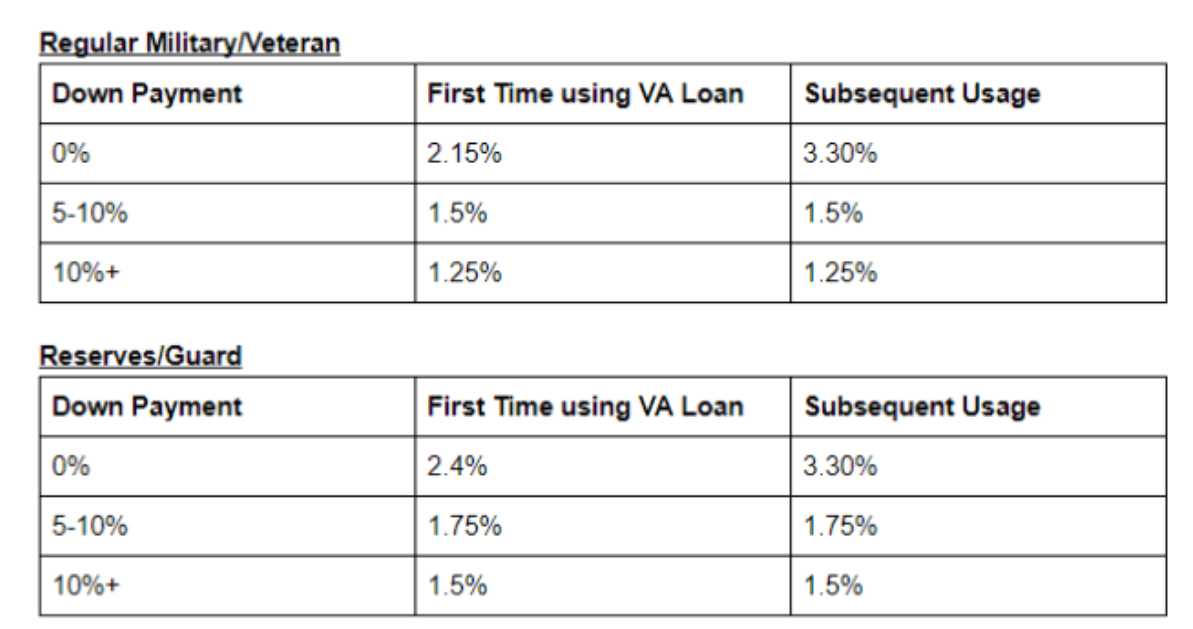
While it is true that a traditional down payment is not required, everyone who borrows for a home via a VA loan is required to pay something called a “funding fee” (with the exception of veterans and service members who are receiving disability compensation).  That aside, the VA loan funding fees are broken up as follows:
 

screenshot_20171228-105531444484889.png

There are few things to note about the funding fees.  First, these funding fees may be rolled into the mortgage if desired, allowing you to further lower the upfront cost of purchasing your new home and instead paying it off over the lifetime of the loan.  Next, you’ll notice that the subsequent usages of the VA loan only increase your funding fee if you are making NO down payment – as such, if you’re going to purchase more than one home using the VA loan, it makes a lot of sense to have at least a 5% down payment ready to go.


For those that don’t know, the VA has a few stipulations in order to gain a mortgage through them: You must have served 181+ days in peacetime/90+ days in wartime/6 years in the Guard or Reserve, reside in the home as a primary resident, and  must not have been discharged under dishonorable conditions. If you meet these conditions, you’re eligible for the VA loan, up to the maximum entitlement of $424,100 or specifically, $106,025 in actual entitlements – This isn’t the actual loan amount, but rather how much the VA will guarantee for you.  Remember earlier how we mentioned PMI and risk to the bank? The reason VA loan rates tend to be lower and there’s no need for PMI is that the VA actually usually guarantees 25% of your loan amount.


Here’s how the math works: Say you purchase that $200,000 home and use the VA loan, while meeting all of the requirements.  You then PCS a few years later and want to buy a home at your new location as well while renting out your old home rather than selling it.


$424,100 x 25% = $106,025 maximum entitlement

$200,000 x 25% = $50,000 used entitlement on first home

$106,025 – $50,000 = $56,025 entitlement remaining

$56,025 x 4 = $224,100 actual home purchasing power remaining


Alternatively, you can just subtract the purchase price of your home from $424,100 to find what’s remaining, but I find it can help to understand the underlying principles.


Now that we understand the specifics of the VA loan system, it’s time to start looking at getting that mortgage! Besides the FHA/conventional/VA types of loans, there are also two major subtypes of mortgages: fixed and adjustable-rate. Generally, when we’re talking about fixed, we’re talking about 15 year and 30 year mortgages (although there are other timelines available), while with an adjustable rate (generally referred to as an ARM) we’ll talk about something called a “5/1 hybrid ARM” as an example.


A fixed rate mortgage is just that: a mortgage with a fixed rate! Your monthly payments will never increase, nor decrease without refinancing on a fixed rate mortgage. This can be a major benefit, as you know exactly what your monthly mortgage is going to be for the next 15/30 years (barring major changes in taxes or homeowner’s insurance). When you choose a fixed rate mortgage, you are provided an interest rate, which is generally higher the longer the term of the loan. This is because as time goes on, interest rates will change, and the mortgage provider is hedging their bets and lowering their risk by providing you with a slightly higher, guaranteed price over the next 15 or 30 years.


On the flip side of this, we have ARMs (the Adjustable Rate Mortgages) – these can fluctuate from year to year, based on the current interest rate. The numbers in front of it refer to how often these rates can be changed – in our 5/1 example, the 5 means you’ll have 5 years before your rate is eligible to change at all, and the 1 means that your rate will be eligible for change every year after that. For VA loans, your rate can only increase by 1% a year, and up to 5% over the lifetime of the loan.  While they often have slightly lower rates, they make up for it as the loan matures and your mortgage payment can increase year to year and cause financial hardship. The benefit is that you can often get a lower rate compared to a fixed rate mortgage, since the bank isn’t taking on as much risk – they can just raise your rates later on if interest rates go up.


As an example, let’s look again at that median $200,000 home and assume you got a 5/1 ARM on it with a 3% interest rate.  This would mean you have a monthly payment of $843. For 5 years, your payment would continue to be the same, but in the 6th year, your interest rate goes up by 1% increasing your monthly payment to $954. The next year, it could increase again by another 1% to 5% total, this time increasing your monthly payment to $1,073 and so on and so forth… In this example, the highest it could cap is at 8%, or a whopping $1,467 monthly payment – a hefty increase from our start of $843! While this exact scenario isn’t very likely, it’s definitely possible, and it’s a major reason why most people don’t recommend pursuing an ARM unless you know you’re going to be living in a house less than the amount of time you’ll have the fixed interest rate – in which case you should just consider renting as our calculations showed before.


One final point to think about when looking at a mortgage is just that– points! A “point” in this context is a way for you to essentially prepay part of the interest on your mortgage loan, which mortgage providers will reward you for with a lowered interest rate. You can also have negative points, where you can receive money during closing towards costs but will result in a higher interest rate. These points are tax deductible, and lenders generally allow anywhere from 0 points to 3-4 points on a loan. This will vary from lender to lender, and the benefits of doing so can also fluctuate, so be sure to shop around!


As an example, we’ll go back to our loan from earlier for $200,000. Each point is equal to 1% of the loan amount; so 1 or 2 points would be equal to $2,000 or $4,000 respectively. Say that your loan provider offers a 0 point loan at 4%, a 1 point loan at 3.5%, and a 2 point loan at 3.25%. The 0 point loan would have a monthly payment of $955, the 1 point loan would cost $898 a month, and the 2 points would lower the cost to $870 each month.


0 Points: $955 per month

1 Point: $898 per month ($2,000 paid) = $57 saved per month – 35 months to break even

2 Points: $870 per month ($4,000) paid = $85 saved per month – 47 months to break even


Any time you’re looking at a mortgage where they offer points, it’s worth doing the math and finding the exact break-even point and comparing that with how long you expect to live in (or make payments on) the house – in this case, the 1 point may make sense if you plan to live in the house for more than 3 years. As with any major purchase decision, make sure you’re doing the math for yourself and comparing your options and shopping around!


In this post, we covered the differences between conventional mortgages and those backed by the VA, how PMI works, VA loan funding fees and down payments, VA loan minimum requirements and maximum entitlements, fixed rate and adjustable rate mortgages, and finally points and how they affect your mortgage. Hopefully you learned a lot about the math and decision making behind a home purchase; in our next post, we’ll look at more of what to expect during the loan and home purchasing process!


Sources:
http://www.bankrate.com/finance/mortgages/the-basics-of-private-mortgage-insurance-pmi.aspx
https://www.veteransunited.com/valoans/va-arm/
https://www.benefits.va.gov/homeloans/documents/docs/funding_fee_table.pdf

When should I buy a house as a military member?  AKA – why renting is NOT a waste of money.

(This is part 1 of a multi series of upcoming posts about home ownership, VA loans, and how to profit while utilizing the benefits we get.)

As my rotation in this deployed location comes to an end, more and more I hear discussions about what people are going to do with their money.  Some are taking trips, some are buying new vehicles, and many are talking about home ownership.  When pressed on why they want a house in particular, the majority of them have the same answer.

“I am sick of wasting money on rent.”

Let me make one thing perfectly clear before we start any analysis with math, or hypothetical numbers.  Renting is NOT throwing away money.  Renting gives us the freedom, especially as military members, to walk away from one property to the other during PCS season, deployments, when our family size changes, or for whatever other reason.  It gives us the ability to not have a second thought about that AC breaking or how we will pay for the new water heater.  These things are especially important while we are thousands of miles away and are without the ability to make phone calls or even send e-mails.  Additionally, it gives us a chance to pack up the place and put everything into storage while banking that sweet, sweet BAH during a deployment.  Say it with me now.  Renting is NOT a waste of money.

“But look, the landlord is getting rich off of my BAH, I could be the one getting rich off of my own BAH!”

Come to a full stop there.  Owning a house is a risk just like any other investment.  Unlike the majority of other investments, it may be the LEAST liquid.  (Liquidity, in this sense, is used to describe how easy it is to convert an asset into cash.)  Additionally, you have to worry about things like vacancies, depreciation, buying/selling fees, and of course – maintenance.  

Now that that is out of the way, let’s look at some average numbers.

The median home in the US that is being bought/sold is $200,000 (as of June 2017) according to Zillow.  Of course, that number will ultimately depend on the size of the house and possibly more importantly location as well as some other factors such as the materials used and so on.  Since people are stationed from Travis/Los Angeles/Seattle/other HCOL areas to middle of nowhere LCOL places as well, this is the number I will use for the hypothetical situations I will calculate out.  $200,000 will cost you a VA funding fee of $4,300 if it is your first loan that is usually rolled into your mortgage.  In addition to the cost of the house, you will be responsible for paying property taxes and insurance.  They will typically be 1.2% of the home’s cost and .35% respectively.  A 30 year mortgage with great (720+) credit using today’s rate of 3.875 (or 4.047 APR) will ultimately cost you $1,219/month.  

Keep in mind that this will lock you in for 30 years (or until you ultimately determine to sell the property).  Additionally, taxes often go up and very rarely do they go down.  Insurance prices will also typically increase from time to time.  While these prices will not be significant, it is something to consider.

Additionally, (nearly) everything in that house is now your responsibility.  Please do not think that a home warranty will cover everything, either.  Home warranties exist to make money.  They will nickel and dime you as much as possible and will fight you about a replacement, even if it makes more sense to do that vs yet another patchwork repair.  So let’s bring up some of the recurring things you’ll need to fix.

  1. Roof – possibly the most expensive regular item you will have to consider. Homeadvisor.com lists an average national roof replacement price of $7,164.  Warranties for most roof expire at 10 years, but they usually last for about 20 years.  That’s an additional extra total expense of $29.85/mo

  2. AC – another pricy and regular item that needs repairs and replacements.  An AC usually lasts for about 15 years, although after the 10 year mark it may make more sense to get a replacement over a repair.  Average price is $5,230 using homeadvisor statistics.  Using the 15 year mark, that’s another $29.06/mo

  3. Furnace – Using the same website to be consistent, their average price is $4,180.  Many AC techs will advocate for a furnace replacement at the same time as the AC.  However, the newer furnaces can last from 15-25 years, so I will use 20 years for this purpose.  This expense will add an additional $17.42/mo

  4. Water heater – depending on what kind you get, this has a big difference as well.  A tanked water heater runs approximately $1,000.  A tankless is approximately $3,000.  Tanked water heaters last 10 years on average while tankless ones last for 20+.  The price per month then becomes $8.34/mo or $12.50/mo.  

  5. Windows – Windows will typically be rated for 10-20 years.  Because windows are usually an afterthought for most people and do not get replaced until absolutely necessary, we’ll use the 20 year number for this.  Adjust your price accordingly.  An average window replacement house across the US is $5,011 or $20.88/mo

  6. Flooring – this will likely have the biggest variance due to the greatest amount of choices on materials.  Carpet will need replacement more often.  Vinyl/Linoleum slightly less so.  Hardwood and tile will be the most resilient.  

    1. Carpet – national average of $1,586.  California law dictates that carpet’s useful life is 8-10 years.  At 10 years replacement, the cost is $13.22/mo.  This does not include carpet cleaning in the meantime.

    2. Vinyl/linoleum – vinyl lasts from anywhere between 10-20 years.  Linoleum lasts from 20-40.  Since most people care relatively little about their flooring unless there are serious issues with it, I’ll use the max time for both.  Their costs are similar and the national average for this replacement job is $1,362.  The monthly cost then breaks down to $5.68/mo and $2.34/mo respectively.

    3. Hardwood flooring – Average price for this is $4,404.  The life expectancy really depends from 20-30 years for engineered wood or potentially the lifetime of the house with real wood, if properly taken care of.   Using a 30 years replacement figure (or maybe first install), this will cost you $12.23/mo

  7. Appliances – your washer and drier, fridge, microwave, oven and the like will all need to be replaced with similar life expectancies of about 10 years.  After personally shopping for the above, I think $2,000 is a fair low range average.  This brings the average extra monthly cost to $16.67/mo.

  8. Misc expenses – While truly unquantifiable, you need to consider things like sink fixtures, bathtubs, toilets, lawn care, interior and exterior paint, the occasional plumber/electrician/HVAC tech calls and the like.

Not counting item 8, this brings your previous $1219/mo to at least $1,343.56 if you use the low ranges of those replacements.  Going with higher ranges/quality items will increase that figure proportionally.  Do you know how much you pay for the above while renting?  In most cases – NOTHING!

Of course some areas are very obviously tilted towards owning almost no matter what the other circumstance are, but those areas are getting more difficult to find since investors will be looking to buy out those locations to rent out.  

Not counting those outliers, assuming you are ok with the above because you believe you are “building equity” and “paying yourself”, you have to consider what happens once you PCS.  Because you put 0% down, you have no equity in the house to start off.  The overwhelming amount of your payment will go into interest rather than the principal amount borrowed.  While you did not have to pay any kind of commissions while buying, you will likely have to pay them while selling.  The total average commission is 6% (3% to buying/selling agent) which amounts to $12,000 when selling that $200,000 house.  $12,000 will take you over 3 years – or 39 months to be exact – to reach if you are lucky enough to qualify for that 4.067% APR.  Still think renting is a waste of money?

Keep in mind that that those 39 months are for you to walk away from the house purchase with $0 to your name, even though you have spent at least $47,541 without counting ANY replacement/maintenance fees ($1,219/mo).  Unfortunately, I was unable to find any data on today’s statistics, but according to an article on militarytimes.com(1) from September 2015, the military moves at least half of its service members anywhere between 32-38 months.  Of course there are outliers, but this is strictly the average.  As you can see, that time frame is a bit lower than the 39 months you’d need to break even on that house purchase.  You also need to account for the time to sell.  While some housing markets close within a week of making the house available for showing, others take weeks and even months.  My first house, for example, was on the market for almost a year while the owner (a captain) continued to pay mortgage for an empty place throughout that time period.  Talk about throwing money away!

Of course, it is not all doom and gloom about home ownership.  Like I said before, you get nearly complete control of whatever you want to do with your place, which you can’t put a price on.  You also have a unique situation of buying a home without having to save tens of thousands of dollars or pay for Property Mortgage Insurance (PMI) and, given proper research, can turn it into a successful investment.  In the near future, I will be going more in depth over real estate investing and how the VA loan can be used to help.

The bottom line is that while ownership is far more expensive than it seems, it can indeed be more beneficial to renting, especially in areas where the rents are vastly over priced in comparison to the home of the houses.  It’s up to you to do the research necessary to see whether that is the case or not around the location you are at.  I am hoping that this will encourage folks to do that research instead of just jumping on the propagated train of thought that “renting is a waste of money”.

If you have rationally decided that purchasing a house is the best plan of action for you, I will be tackling what exactly the VA process entails and some of the issues you may face while going through the home buying experiences in the next post.

  1. https://www.militarytimes.com/2015/09/12/pcs-costs-rising-across-the-force-even-as-moves-decline/

  2. The reason why most averages are from homeadvisor.com is due to the direct responses of various members.  This seems to make sense to get averages from as all responses are based on multiple thousands of data points.

Credit Scores – what is it, why is it important, and how to improve it?

Credit (and credit cards – which I will tackle with the next post) related questions are rather popular in the military.  Many people that enlist or even commission never get told the details about credit scores and why it is better to have a good score.  We all know or at least heard of someone that buys a car out of tech school with 15-20% interest rate and is always short on cash.  Well, to prevent that from happening, having a good credit score is essential.   Hopefully this post sheds some light on the various basic questions about it.

So what is a credit score?

A credit score is a number that is based on a combination of various financial factors.  It is the most important thing when it comes to interest rates on auto, home, personal and any other kind of loans.  The most common credit score that is used is known as the “FICO” score (http://www.myfico.com/).  While this will be geared towards that particular score, you can apply the same fundamentals towards any other credit score aggregates.  Essentially, a credit score rates your “trustworthiness” to pay off debts.  The higher the score, the more you have demonstrated to not be a liability to lenders.  The FICO score ranges from 300-850.

Think of it this way – if two of your friends or coworkers came by and asked you for some money and you know that one is very responsible with finances, but he just had an emergency while the other is constantly asking people to borrow funds for daily expenses, cancels various plans because he can’t afford them, or even gets his car repossessed for missing payments, who would you rather loan that money to?  My guess is that you would pick person #1.  This is exactly what the credit score figures out.

Why is a credit score important?

A credit score ultimately governs most things in our adult lives that have to do with money.  You want car insurance?  Having a good credit score can (and usually will) decrease your premiums.  You want a loan on that cool new car?  A better credit score will lower your interest and save you money.  Home loan?  Credit score will determine your interest rate there as well – which will have an impact on the overall amount that you can borrow.  If you want a “premium” credit card for perks, the company will check your credit score for eligibility.  For the military specifically, not only can having a bad credit score prevent you from joining the military in the first place, but it can also jeopardize your clearance (if you have one).  It can also have an effect on renting a place, or even getting civilian employment after the military.

What affects my credit score?

While many financial situations affect your credit score, some are more important than others.  The most important thing in a credit score is your ability to pay your bills ON TIME.  This includes credit cards, loans, and even your phone bill or rent!  With credit cards or anything else you finance, it is important to note that paying the total amount is not as critical as making sure you at least make the minimum payments on all of your debts.

That does not mean, however, that paying things off in full is NOT important.  The second most critical thing to your score is the total amount you owe across all of your loans / lines of credit vs your available credit (also known as your utilization ratio).  The lower your utilization ratio is, the higher your score will be.  Because your utilization changes every time you pay on your loan or credit card balance, only the past month is used to calculate the score.  

After those two big ticket items, things like how long your line of credit has been open, the various types of credit that you hold and how many “credit pulls” (when banks formally check your credit) you have in the recent history as well as how many new accounts you recently opened.  

***IMPORTANT NOTE***

There have been multiple reports of credit cards not disclosing your balance to reporting agencies if you paid it off in full before it posts every month.  To clarify – if you make a purchase of $10 on the 2nd and pay it off completely on the 3rd, when your card closes out on the 5th, it will show you had no balance all month.  While you can pay off a little bit off during the monthly period, make sure you have a little left over for the time of the statement posting to ensure it gets reported.  Essentially, do not pay the CURRENT balance in full, but rather focus on paying the STATEMENT balance in full.

Misconceptions about increasing your credit score.

There are a lot of “armchair” experts about money matters, and credit is no different.  Some people will advocate for you to keep a balance on your loans to establish a “history”.  Others will tell you to get a loan just to “build credit” when you can pay off the item in cash.  Some will swear their credit score is (near) perfect and they just do not believe in a credit card… While these things will certainly impact your credit score, and as long as you pay at least the minimum balance every month will give even increase it, these statements are crap and your friend that may be advocating these things is a moron.

Let us start with keeping a balance.  This is a TERRIBLE idea if you can pay off the total amount.  Never carry a balance “just because”.  Since the average Credit Card APR is upwards of 15% and even having the SCRA caps it at a whopping 6% limit, you end up GIVING THAT MONEY AWAY FOR NOTHING!  While it is true that your credit score will go up by doing this, it is not because you are paying interest, but strictly because you are paying every month.  The bank does not count how much interest you have paid for the month, but rather just your balance and if you paid on time or not.  Thus, if you paid attention to the post above, paying off the card in full will still show that you are paying every month and will also lower your utilization due to having less debt to your name.

Getting a loan will do the same exact thing as above.  You are paying someone interest for no good reason and decreasing your total net worth (and thus worsening your utilization).  Do not do this unless you are getting a 0% APR loan as that is essentially free money due to inflation.

Lastly, we have credit cards.  Not getting a credit card can be advantageous if you have poor self-control and will feel the urge to max it out.  However, credit cards will give you the best “bang for the buck” towards your credit score due to having that extra utilization available.  i.e. if you have a CC that has a limit of $20,000 and you have nothing on it, you have an extra $20,000 you COULD be borrowing.  In addition, most cards will have some kind of “cash-back” or “bonus points” programs where you will make some of your money back.  I will address this more in depth in my next credit-card focused post.  Lastly, many credit card companies now give you a free credit score based on their available information.  While this will likely not be exactly the same number that a bank might get while doing an official inquiry, it is usually within 20-30 points.

If you have any additional questions or would like clarifications, feel free to give me a shout!

SDP vs (Roth) TSP on deployments.

After doing a few squadron topics about finance, I’ve been labeled as the “go-to guy” for money matters on my current deployment.  During a previous Commander’s Call, our First Sergeant brought up the Savings Deposit Program (SDP) and how great of a program it is for saving.  Naturally, I had a few people pull me aside with questions regarding the program and how good is it – REALLY?  

On my first deployment, as soon as I heard of this SDP and its guaranteed 10% interest, my eyes lit up and I maxed it out as soon as I can.  However, these days I am a little wiser and also slightly more critical of the program.  So when I was faced with questions on the SDP and its wonderful “cure all” sales pitch, my answer to the question of its worthiness is –

It depends.

“What?  Depends!?  It’s free money!”

Well, not so fast.  Let’s go over some of the basic rules and issues that one runs into while talking about the SDP.  Now let me preface this that the below are straight FACTS and both the TSP and the SDP serve two completely different purposes.

  1. While you can deposit $10,000, you cannot deposit it at once to take full advantage of the 10%

Of course the 10% on the $10,000 figure is THE selling point of the program.  Our mind has evolved to fill in the blank where given the figures above, we will get a FREE $1,000 out of the deal.  If that was the case, I would be the biggest proponent of the measure!  Unfortunately, it is not so.  Your “Deposits may not be more than the amount defined as un-allotted current pay and allowances in subparagraph 510201.B.” (1) This means that it will take you months to get to the $10,000 limit.  Additionally, you have to wait until the 31st day in a combat zone prior to making contributions.  So not only are you already behind the curve from not being able to put in a cool $10,000, but you are also 31 days behind in your 10% interest (in reality – 2.5% compounded quarterly averaged over your 3 month balance – i.e. if you put in 5000 every month, it would be an average of (5000+10000+10000)/3 x 0.025, or $208.33 in interest instead of 250 during your first 3 months) and you are only able to keep the SDP open (while it still gathers the interest) for 90 days after your return from the deployment.  Of course there are many people in finance positions that do not know the regulation (or just do not care) and will allow an immediate deposit making it more worthwhile if it’s your emergency fund.  In my personal experience however, that has not been allowed in either of my deployments.


***IMPORTANT NOTE***

Some deployed finance offices will allow you to put in $10,000 immediately.  At times this will also require a letter from your squadron commander.  If you are in a lucky position that allows this, do not hesitate to put the money in immediately if you have it sitting around in a plain checking/savings account.

  1. You’re letting finance “control” your money.

How many times do we hear news of finance screwing up our pay?  It has happened to me just about every year that I have been in.  From computer, to personnel errors, I have had my money tied up for months before seeing it back in my accounts to swift withdrawals that a couple of times –  I was not even made aware of!  Doing some extra research on the SDP, I have found multiple people claim that they were thankful they kept their receipts because finance would lose records of the deposits those people made and had general issues with deposits and vouchers.  The majority of folks will not have these issues, but it is still an extra headache/risk.  Of course if you have various allotments set up, that may cause more headaches – especially if you are trying to max it out ASAP as you will not be able to put in 100% of your entire pay until the allotments have full stopped.

  1. Math section!

I will attempt some napkin math here for the TSP vs SDP discussion for someone that is able to save $4,500 and someone that can only save $3,500.  

For the sake of simplicity, let’s say that in lieu of the TSP, I want to max out my SDP first and use my current figures.  Base pay + BAS + BAH + HDP + HFP/IDP + Fam Sep + COLA = 6562.48.  However, we have to deduct everything else we have going on such as Soc Security/Medicare and I get a total of 6309… since we are overseas and need to keep paying for rent as well as some additional bills we have (her food, cell phone, gas, etc), I will say I am able to save roughly 4500/mo after my family NEEDS are met.  I will also do a calculation for 3500/mo.

* Let me jump in here and say that in reality, I am nowhere close to these numbers during my current deployment.  Unfortunately we had to pay for my wife to fly back to the US and back, and after other family emergencies along with additional random expenses, we could not hit the savings target we aspired for.  However, if you are trying to be a great military saver and are strictly focusing on maximizing these avenues out, I believe these numbers are a good starting point.  

So back on track, we will deposit 100% of my base pay into my TSP (I’m a 6 year SSgt/E-5 – 2856.60). The other (4500-2856)=$1644 left over will go towards mine and my wife’s Roth IRAs for extra tax benefits and over 7 months will both be maxed out.  At month 8, I will drop the TSP to my current TSP contribution number of 30%, or 856.98 as this is the time I would be returning home.  

For the SDP side, we will assume a deposit of 100% of 4500 into the SDP to get the most out of the 10% yield.  Once the SDP is maxed, we will go with the above of throwing in the money into the TSP.  At the 9 month mark, we will take out the 10750 in the SDP and add it with all other contributions for monthly growth noted below.  I did NOT calculate taxes in this, but after reading the above taxes section you should be aware that you are losing a significant chunk of change with this money not being in a tax-advantaged account.

I will use a standard 7% annual interest for the TSPs calculation (or .58333% monthly) and a 10% (or 2.5% interest every 3 months) for the SDP calculation.  As the interest in the SDP is accrued based on the average amount over the quarter, the first period will not be a flat 250, even if you did max it to 10k in time.  I will also use a standard 180 day deployment for the USAF so you have your 6 months of SDP interest in theater, and then the additional 90 days once you get home:

4500/mo

Month 1

Month 2

Month 3

Month 4

Month 5

Month 6

TSP/IRA

4500*1.00583333

4526.25

(m1+4500)*1…=
9078.90

(m2+4500)*1…=
13658.11

(m3+4…)*1…=
18264.03

(m4+4…)*1…=
22896.82

(m5+4…)*1…=
27556.63

SDP

4500

9000

10k+(23500/3)*.025
10195.83

10195.83

10195.83

10000*1.025+250
10445.83

SDP + TSP/IRA after

4500

9000

SDP+(3500)*1..

13716.25

SDP+(3520.42+4500)*1..

18262.83

SD+(m4-10195.83 +4500)*1…

22836.35

SD+(m5-10195.83 +4500)*1…
27686.16

4500 cont

Month 7

Month 8

Month 9

Month 10

Month 11

Month 12

TSP/IRA

(m6+4…)*1…=
32330.18

(m7+856.98)*1…=
33380.75

(m8+8…)*1…=
34437.45

35500.31

36569.37

37644.67

SDP

10445.83

10445.83

10695.83

10695.83

10695.83

10695.83

SDP + TSP/IRA after

SDP+(m6-10445.83 +4500)*1…

32312.98

SDP+(m7-10445.83+856.98)*1…

33302.52

SDP+(m8-10445.83+856.98)*1..

34547.83

SDP+(m9-10695.83+856.98)*1…

35548.95

SDP+(m10-10695.83+856.98)*1…

36555.90

SDP+(m11-10695.83+856.98)*1
37568.73

3500/mo

M1

M2

M3

M4

M5

M6

TSP/IRA

3500*1.00583333

3520.42

(m1+3500)*1…=
7061.37

(m2+3500)*1…=
10622.98

(m3+3500)*1…=
14205.36

(m4+3500)*1…=
17808.64

(m5+3500)*1…=
21432.94

SDP

3500

7000

10k+(25000/3)*.025
10170.83

10170.83

10170.83

10420.83

SDP+TSP/IRA

after

3500

7000

SDP+(500)*1.0058333
10673.75

SDP+(502.92+3500)*1..

14197.10

SD+(m4-10170.83 +3500)*1…

17741.00

SD+(m5-10170.83 +3500)*1…

21555.58

3500 cont

M7

M8

M9

M10

M11

M12

TSP/IRA

(m6+3500)*1…=
25078.38

(m7+856.98)*1…=
26086.65

(m8+8…)*1…=
27100.80

(m9+8…)*1…=
28120.87

(m10+8…)*1…=
29146.89

(m11+8…)*1…=
30178.89

SDP

10420.83

10420.83

10670.83

10670.83

10670.83

10670.83

SDP+TSP/IRA

after

SD+(m6-10420.83 +3500)*1…

25140.95

SD+(m7-10420.83 +856.98)*1…

26088.80

SD+(m8-10420.83 +856.98)*1…

27292.18

SD+(m9-10670.83 +856.98)*1…

28251.12

SD+(m10-10670.83 +856.98)*1…

29215.65

SD+(m11-10670.83 +856.98)*1…

30185.81

So as you can see above, there is some difference between the two different sums of money.  With the $4,500, the TSP comes out ahead overall due to the higher amount being put into the TSP to compound monthly.  With $3,500, since you still max out the 10k in the first 3 months and the TSP gets a little less to compound, it comes just slightly behind.  Nevertheless, due to the taxes reasons below, I would still 100% advocate for the TSP over the SDP.

  1. TAXES

Although your income in a combat zone (and even some non-combat zones) will be tax-free, the interest you earn in the SDP IS taxable.  This is honestly the biggest reason for me.  Even though the numbers are VERY close (as you will see in the “napkin math” I provided below), after you take the tax out for the 750 gain and future tax implications, it doesn’t make as much sense to do the SDP over the TSP.  Additionally, as I am saving for early retirement through various investments, I want to have as much money as I can in tax-advantaged accounts where I will not have to pay taxes on it later.  

If you use the calculator the smart folks made at CalcXML (https://www.calcxml.com/calculators/inv07) and plug in $10,000 with a 7% yearly yield compounding monthly over 10 years (let’s say this is when we’ll retire from the military and start withdrawing our TSP then – more talks about early withdrawal techniques to come!) while somehow able to stay at the marginal tax rate of 15%, the difference between taxable vs tax-advantaged savings are almost $2,000!  At 20 years, that difference is nearly $7,500.  If you bring your marginal tax bracket to 25%, the difference is even higher at $11,639.

  1. Final verdict

As you can see from the math above, the TSP is a much better place to park your money when you account for the tax free growth no matter the circumstance.  However, I will concede that if you are in a position where you need to start your emergency fund or have to spend that money on an upcoming purchase (i.e. home downpayment or any kind of big purchase), the SDP is still better than a checking/savings account and far safer than putting it in a market where you might lose money short term.  Ultimately, you know your position and priorities best, but hopefully this article has shown you enough to let you make a more informed decision.

References: (1) DoD 7000-14-R (Para 510205 A) 

How to start on the path of financial success.

Every week the military gets new members either through basic training or officers getting their commission.  Many of them have only recently graduated high school or college and this will be their first step in being independent.  It is a scary, exciting feeling for many and very easy to get overwhelmed.  Among many questions they ask, one seems to be constant:

What should I do with my money?

The majority of people entering the military will have very limited (if any) financial education and all of a sudden significantly more money than they have been used to.  Most of them have been used to having things pre-budgeted for them, whether because they lived at home and had little to no expenses (or income), or because their schools have allocated their financial assistance/scholarships through the right channels automatically, making financial planning that much easier.

Admittedly, the world of personal finances and especially investments is very vast and easy to get overwhelmed in.  There are rules about what % you should save, and what to spend where everywhere you look and many are either outdated or make sense for your coworker, but not you.

Luckily, there are a few universal truths which, if followed, will set you up for success in or out of the military.  So how do you get on that financially successful path?

  1. Spend LESS than you earn

Seems pretty self-explanatory, right?  If only that was the case!  It is so easy to go out and get a car and have a payment that leaves you with just enough to cover insurance and gas.  You think to yourself – well, it’s brand new and under warranty, so things won’t break and since I have a meal card and the dorms (or BAH/BAS), I have no other expenses!  However, things DO happen.  A tire blowout or windshield crack won’t get covered by insurance for example, but since you recently got yourself a star card with a few hundred dollar credit limit, you max out and think you’ll be ok.  Then, you get notified that something happened at home and you need to take emergency leave (and incur travel costs) to go back.  It snowballs quickly and next thing you know, you’re standing in your commander’s office trying to explain your finances and irresponsibleness and possibly facing discipline which will do even more harm to your financial situation.

I say all of the above because I have seen it.  My first roommate when I moved off base couldn’t afford to get a 6-pack of beer outside of a payday weekend multiple times because of his car payment, insurance, cell phone and the occasional lunches/dinners/bars with co-workers he went to that month.

  1. Pay YOURSELF first

Now, I will caveat this with the following: if you have prior debts that are high in interest (generally anything above 5%), pay THEM off first.  Once you have broken even, then heed the following advice.

You should set aside at least 10% to go to your savings.  Now, when I say 10% for the military folks, I mean 10% of your TOTAL paycheck – not just your base pay.  First, set aside an emergency fund to last you at LEAST 6 months and to cover the major things that might come up.  Have enough to fly home in case something happens with your family members.  Ensure you are able to pay the car repair bill if something big happens (blown transmission, etc.).  Once that’s done, setting a 10% figure in your TSP through mypay is great, but after you add in the various allowances that we get, it’s not very much in comparison.  

Also keep in mind that 10% savings rate – while a lot better than the average working person today – is still not enough to get you to retire early in most circumstances.  It will, however, set you up for success at retirement age and prevent you from having to work into the grave.  Of course depending on your pension benefits and other investments you may make throughout your career, you still might be able to do so, but that will be covered more in depth in the future.

  1. Build the life you want prior to saving for it

Imagine the future at your retirement.  Think about what you want at that moment.  For some, this might mean a cottage in the woods surrounded by acres of land.  For others, they are fine with a small bungalow as long as it is with their family and loved ones.  Everyone’s dreams and priorities are different.  The point is – do not lose sight of what is truly important to you just to save a few dollars.  If you want to have experiences with your significant other, HAVE THEM, just do so responsibly.  Do not focus so much on the future that you lose sight of the present.  Now, this does NOT mean for example, that if you are into cars, you go out and finance a $70,000 BMW or Mercedes.  Think instead of buying a used vehicle that will do what you want while setting aside a few hundred dollars for upgrades to the car, or maybe for a future purchase.

At the end of the day, being a slave to money because you are constantly in debt is an awful feeling, so is being a slave to money because you are trying to maximize every single cent into retirement funds.  

While the above are very basic – and I do not want to overwhelm those who may be new to saving – If you follow these three VERY basic tips, you will be on the path of financial success